29.12.10

Chester Performs 'Up The Wall' Event

UP
THE
WALL 

The ancient City Walls in a new light.
Chester is a walled city and its wall is inescapable... 

Home, shelter and source of security or symbolic divide, fortress or personal prison?
From Israel to Belfast, Berlin to Chester a group of UK and international artists come together to explore what walls mean to them.Interactive digital graffiti... trumpets heralding the fall of Jericho... divided families digitally rejoined... Lady Macbeth haunting the turrets...
Performance and intervention: Michael Pinchbeck/The End - Tom Marshman - Roy Maayan + Anat Katz - Natalie Preece + Darren  White - Megan Broadmeadow - Worldshed
Installation: Noise Club - Wild Strawberry - Hagar Cygler - Articulating History - Jo Ashbridge - Isobel Anderson - Louie+Jessie - Forecast
Specially commissioned flickbook: Rachel Henson
Up the Wall is an evening of images, sounds, animated journeys and performances - thought-provoking, playful or downright bizarre, in a whole new focus on an ancient construct.


Noise Club, Wild Strawberry, Worldshed, Hagar Cygler, Articulating History, Jo Ashbridge, Isobel Anderson, Roy Maayan & Anat Katz, Michael Pinchbeck, Natalie Preece/Darren White, Megan Broadmeadow, louie+jesse, Anna Macdonald, Tom Marshman, Rachel Henson


Up the Wall 2010 from Chester Performs on Vimeo.

15.10.10

Chester Performs 'Up The Wall'


The ancient City Walls in a new light – a festival of image and sound at nightfall
Friday 22nd & Saturday 23rd October 2010

Join us anytime between 7pm & 9pm
Chester Roman Garden and The Groves


We have two new pieces in the 'Up The Wall' event in Chester a video projection 'Run(g) Out and a sound installation 'To Forget'.

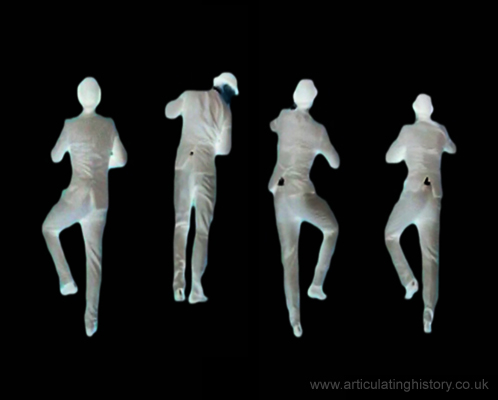
Video Stills from Run(g) Out

Run(g) Out 2010 Video projection, wall and rope ladder


Run(g) Out is a video installation that depicts a climbing male figure, dressed in a suit and bowler hat, projected against a rope ladder hanging from the city wall.   The figure, although apparently engaged in the act of climbing the ladder, is seen to make no progress in his ascent.  Moreover, the film is continually looped so that his climb appears interminable; he never achieves his goal or reaches his destination.

The absurd and unexpected situation evokes the iconography of the surrealist Renee Magritte, the slapstick comedy of Charlie Chaplin, and even the bureaucratic nightmares of Franz Kafka.  The precarious position of the climber is reinforced by the use of the rope ladder, a device associated with emergency escapes and rescue, and a reference to the title of the piece (a ‘run out’ is a climbing term used to describe a lengthy distance between two points of protection which in some, but not all, cases might be perceived as frightening or dangerous).  Whether seeking to escape or to find ‘enlightenment’, the climber will never attain his goal, find the truth or satisfy his desire, just as he is doomed never to reach the top of the wall.


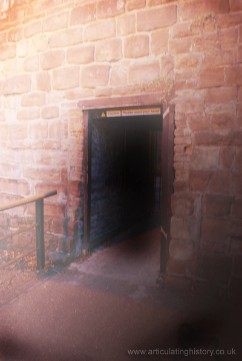
Installation Site

To Forget 2010 Sound, sound equipment

This piece seeks to provoke a visceral response from the listeners as they crouch or strain to hear barely audible tapping sounds emerging from several small speakers located along the length of the passage.  To Forget co-opts the unavoidable associations suggested by the tapping to both intrigue and unnerve the listener, invoking the primitive communications of those individuals incarcerated, confined or otherwise trapped, where they are denied or unable to access more conventional means of communication.

Whether coded in order to relay information secretly, deliberate and sustained to intimidate and disconcert, or a desperate attempt to signal for help, the human activity of tapping is a strategy to overcome isolation and reach beyond barriers and walls.  To Forget situates the listener on the ‘outside’, both physically in relation to the perceived source of the tapping, and psychologically by their inability to determine what is being communicated.  Without the familiar points of reference (voice, visual clues or context), the listener is led to speculate on the origins and authors of the tapping, and its meaning.


Jonathan Alibone & Alexander Small © 2010